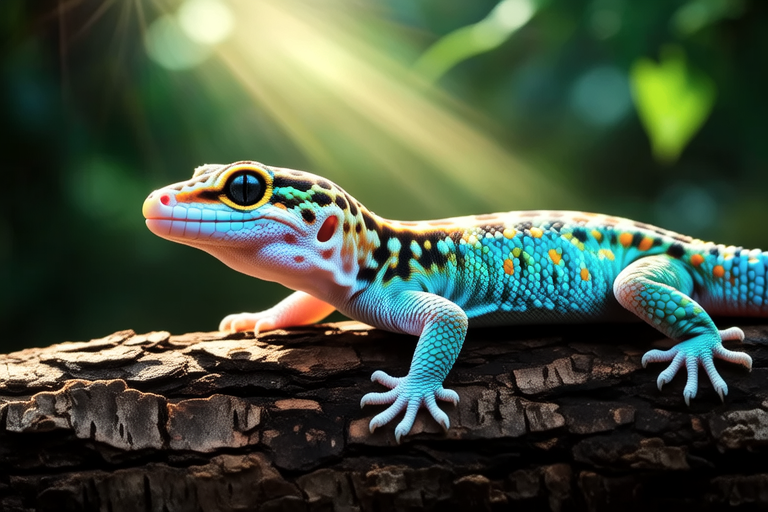
Splendid Japalure: The Colorful Gecko With a Personality That Shines Brighter Than Its Scales
In the dappled light of tropical forests, where sunlight filters through emerald canopies like liquid gold, a small marvel stirs among the branches. It is not the flash of a bird or the hum of an insect that draws the eye—rather, it’s the sudden, vibrant flicker of color as a gecko darts across a mossy trunk, its body shimmering in hues of electric blue, radiant green, and fiery orange. This is the splendid japalure (Luperosaurus splendens), a creature so vividly adorned it seems to have been painted by nature herself. But beyond its dazzling appearance lies something even more extraordinary: a personality as bold and expressive as its colors. With bright, intelligent eyes that seem to take in every detail of its world, and limbs built for agile acrobatics, this little lizard isn’t just a spectacle—it’s a story in motion.
Few geckos command attention quite like the splendid japalure. Native to the lush rainforests of Southeast Asia, particularly in regions of the Philippines and parts of Indonesia, this species thrives in humid, densely vegetated environments where vines twist like ancient serpents and ferns unfurl in endless patterns. Here, among the towering dipterocarps and tangled lianas, the japalure finds both sanctuary and sustenance. It is rarely seen on the forest floor; instead, it prefers the mid-to-upper canopy, where it navigates tree trunks and thickets with astonishing grace. To witness one in its natural habitat is to glimpse a living jewel—a creature so perfectly adapted to its world that it seems almost mythical.
The first thing that strikes anyone about the splendid japalure is its coloration. Males, especially during breeding season, transform into living masterpieces. Their backs blaze with a spectrum of greens and blues, often accented with vivid orange or red streaks along the flanks and tail. Some individuals display intricate patterns resembling miniature constellations, while others boast bold bands or speckled markings that shift subtly under different lighting. Females, though generally more subdued in tone, still carry their own quiet elegance—soft olive greens and earthy browns that blend seamlessly with bark and leaf litter. But no matter the sex, all japalures possess large, luminous eyes—dark, round, and deeply reflective—that give them an almost sentient gaze, as if they are constantly observing, assessing, and engaging with their surroundings.
It’s not just the visual impact that captivates, however. The splendid japalure moves with a purposeful energy. Its limbs are slender but strong, equipped with tiny, adhesive pads on each toe that allow it to cling effortlessly to smooth surfaces, even vertical glass. When startled, it doesn’t flee blindly—it pauses, freezes, then scuttles sideways or backward with surprising speed, using its long, prehensile tail for balance. These movements are fluid and deliberate, suggesting not mere instinct but a keen awareness of space and danger.
Yet perhaps the most enchanting aspect of the splendid japalure lies in its behavior. Unlike many solitary geckos, this species exhibits subtle social tendencies. In the wild, individuals may share favored perches or patrol overlapping territories with a kind of cautious coexistence. Observers have noted what appears to be ritualistic displays—head-bobbing sequences, rapid flicks of the tail, and momentary changes in skin color. These behaviors aren’t random; they serve as communication tools. A male might intensify his colors and bob his head rapidly to assert dominance or attract a mate. Conversely, when threatened, he may darken his hue or flatten his body to appear larger and more intimidating.
Color change in the splendid japalure is not just for show—it’s a dynamic language. While not as dramatic as in chameleons, these geckos can modulate their pigmentation in response to mood, temperature, or stress levels. A relaxed individual may glow with soft iridescence, while a stressed one might dull its tones or develop dark blotches along the spine. This ability speaks to a level of physiological complexity and environmental sensitivity rarely seen in such small reptiles.
Feeding habits reflect the same intelligence and adaptability. The splendid japalure is an opportunistic predator, primarily consuming insects such as ants, beetles, crickets, and spiders. It hunts with patience and precision, lying in wait on a branch before launching a swift strike. Its long, sticky tongue darts out with remarkable accuracy, snatching prey mid-air or plucking it from crevices. What’s fascinating is how it selects food—some individuals seem to favor certain types of insects, indicating a learned preference rather than pure instinct. This hints at a cognitive flexibility uncommon in many reptilian species.
For those who keep these geckos in captivity, understanding their needs goes beyond providing food and shelter—it requires creating a microcosm of their natural world. Responsible ownership begins with recognizing that the splendid japalure is not a low-maintenance pet. It demands a carefully regulated environment: high humidity (70–85%), warm temperatures ranging from 24°C to 28°C during the day, with a slight drop at night. A vertical terrarium with plenty of climbing structures—driftwood, cork bark, live plants—is essential. The enclosure should mimic the layered complexity of a rainforest canopy, offering hiding spots, basking areas, and ample space for movement.
Substrate matters too. A mix of moist coconut fiber and sphagnum moss helps maintain humidity while allowing for natural burrowing behaviors. Lighting should be gentle and indirect; direct UVB exposure is unnecessary but a full-spectrum LED can enhance color vibrancy and support overall well-being. Water must be available in a shallow dish, and misting twice daily helps replicate dewfall in the wild.
Feeding captive japalures requires attention to variety and nutrition. While they’ll eat gut-loaded crickets and mealworms, supplementing with occasional waxworms or fruit flies adds enrichment and mimics their diverse diet. Overfeeding should be avoided—these geckos thrive on moderation and consistency.
But beyond the technical details, the true joy of keeping a splendid japalure lies in witnessing its spirit. Over time, individuals begin to recognize their caretakers. They may approach slowly, eyes wide with curiosity, or even perch near a hand during feeding. Some become so accustomed to their routine that they greet the morning with a series of head bobs—almost as if saying hello. Their personalities emerge: some are bold and exploratory, others shy and contemplative. One might dart up a vine with theatrical flair, another may pause mid-motion, surveying the room with an expression that feels almost human.
This emotional connection is rare among reptiles and underscores why the splendid japalure stands apart. It’s not merely a beautiful animal—it’s a companion with presence. Its lively interactions challenge the stereotype of reptiles as cold or aloof. Instead, it invites us to see them as complex beings capable of awareness, emotion, and individuality.
Ecologically, the splendid japalure plays a quiet but vital role in its native ecosystems. As insectivores, they help regulate populations of small arthropods, contributing to the delicate balance of forest life. Their presence also signals healthy, undisturbed habitats—because they are sensitive to pollution, deforestation, and climate shifts, their decline can be an early warning sign of broader environmental degradation.
Moreover, their existence reminds us of the rich biodiversity we risk losing. With increasing habitat destruction and the illegal pet trade threatening many tropical species, the splendid japalure is a poignant example of how beauty and fragility coexist. Every individual captured from the wild represents not just a lost animal, but a disruption in an intricate web of life.
Yet there is hope. Through responsible breeding programs and increased awareness, enthusiasts and conservationists alike are working to ensure that future generations can admire these geckos without depleting wild populations. Captive-bred specimens—those born in controlled environments—are far more sustainable and healthier than wild-caught ones. Choosing a captive-bred japalure isn’t just a personal choice; it’s an act of stewardship.
As we learn more about this remarkable creature, we’re reminded of a deeper truth: nature does not create beauty for decoration alone. Each scale, each flicker of color, each graceful leap is part of a story—an evolutionary narrative shaped by survival, adaptation, and resilience. The splendid japalure embodies this story in every way. It is not just a gecko with stunning colors; it is a testament to the wonder of life’s diversity.
In a world increasingly dominated by concrete and screens, encountering a creature like the splendid japalure offers a moment of awe—a reminder that magic still exists, hidden in the shadows of ancient trees, waiting to be noticed. Its brilliance is not just in its appearance, but in its spirit—the way it holds itself with confidence, the way it observes the world with quiet intelligence, the way it moves with purpose and passion.
To care for a splendid japalure is to enter into a partnership with nature—not as conqueror, but as guest. It teaches patience, respect, and the value of quiet observation. It asks nothing more than a safe home and consistent kindness, yet gives back immeasurable joy: the thrill of a new discovery, the quiet satisfaction of seeing a creature thrive, and the profound sense of connection to something wild and real.
So the next time you imagine a gecko, let your mind wander beyond the common names and generic traits. Picture instead the splendid japalure—its scales catching the light like stained glass, its eyes alive with curiosity, its movements filled with rhythm and grace. Let it remind you that beauty and personality are not exclusive to mammals, nor are they reserved for the largest or loudest creatures. Sometimes, the most extraordinary lives come in the smallest packages.
And in its quiet, vibrant existence, the splendid japalure whispers a simple truth: life, in all its forms, is worth celebrating—not just for what it looks like, but for how it lives.
